How to Buy Peptides Online in the USA: Shipping, Testing and What to Check
Every substance in this index arrived as chemistry before it arrived as medicine. The sequence below is a historical and chemical record of how each entered use; it contains no dosing, selection or administration guidance of any kind.
Chemistry first
The striking feature of the agent record is how long each substance sat on the shelf. Ether was described in 1540 and used surgically in the 1840s. Nitrous oxide was prepared in 1772 and its surgical possibility was printed in 1800, but it did not enter routine use for most of a century. The gap is not an accident of communication. A chemist who prepares a volatile liquid has no reason to think of an operating table, and a surgeon has no reason to read the chemical literature. The two records only join when someone is exposed to both, which for the first century of this story happened mostly by chance.
The inhalational line
A supplier's certificate of analysis can look flawless and still tell you almost nothing. Batch numbers that do not match the vial, purity figures with no lab named, and shipping terms buried three clicks deep are common. Buying research peptides online in the USA means checking those details yourself.
This article covers what Kovagen supplies, how its U.S. and Canada shipping works, and how to verify a per-batch independent COA, including the 7-panel report. By the end, you will know exactly what to confirm before placing an order.
What Is Kovagen (KOVA)? Who It Serves and What It Supplies
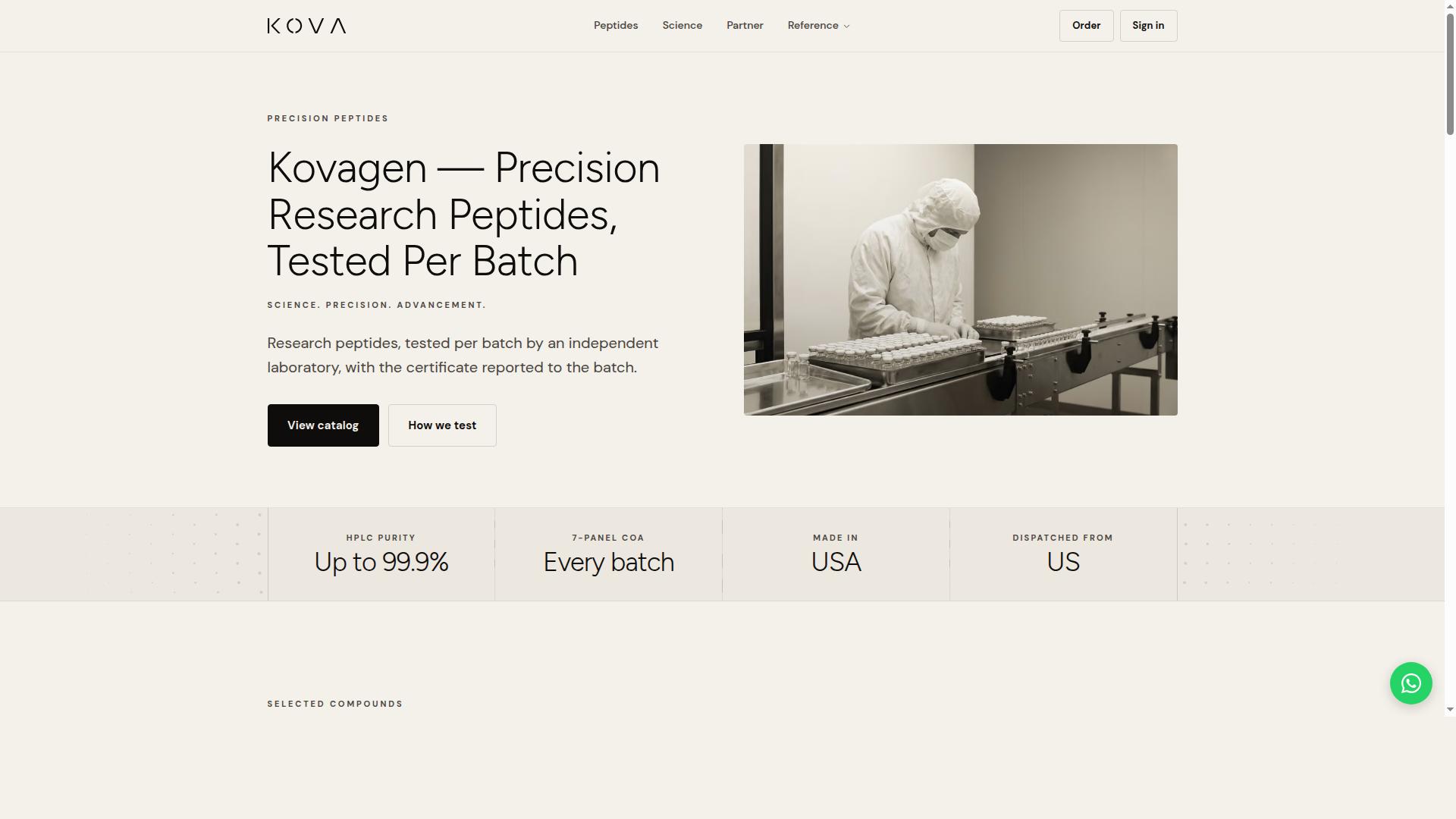
Kovagen (also known as KOVA) is a research peptide supplier that sells lyophilized powder compounds and research supplies to laboratory researchers in the United States and Canada. The brand positions itself around a simple idea: evidence is the product. Its stated motto, "Science. Precision. Advancement. reflects that focus on documented, verifiable materials rather than marketing claims.
What sets Kovagen apart in the peptide vendor landscape is its testing model. Every batch is tested by an independent analytical laboratory, and the results are tied to that specific batch. For buyers who care about COA verification and lot tracking, this batch-level approach is the detail that matters most.
The catalog covers two broad categories:
- Research peptides supplied as lyophilized powder, including single compounds and blends
- Research supplies that support laboratory work with those materials
The lyophilized powder format is standard for research peptides because it improves stability during storage and transport. Researchers typically reconstitute it themselves with an appropriate solvent such as bacteriostatic water when preparing working solutions, following their own laboratory protocols.
Kovagen serves laboratory researchers specifically. That audience is narrow by design. The brand does not market to consumers, patients, or anyone seeking wellness or performance products, and it makes that boundary explicit on every front.
One point deserves emphasis for anyone evaluating this supplier: all materials are supplied for laboratory research use only, not for human or veterinary consumption. This RUO label is not fine print. It defines the legal and practical scope of what Kovagen sells, and buyers should treat it as the central term of any online peptide purchase.
Kovagen operates through Hybrid Tech Rainbows LLC and lists a Sheridan, WY address. For researchers comparing peptide vendors, that kind of identifiable operating company and physical location is a useful transparency signal. It gives buyers a concrete entity to verify rather than an anonymous storefront.
In short, Kovagen is a research-focused peptide supplier built around independent batch testing, a clearly labeled research use only catalog, and a defined audience of laboratory professionals. Researchers who value documented evidence over vague claims will find the brand's model aligned with how good laboratory purchasing should work.
Is Kovagen a Legitimate Source for Buying Peptides Online in the USA?
Legitimacy for a peptide vendor hinges on independent testing, transparent documentation, and clear research-use-only labeling, three areas where Kovagen makes specific claims. Buyers weighing an online peptide purchase can check each of these markers against what the brand publishes rather than taking marketing copy at face value.
Kovagen states that every batch is tested by an independent analytical laboratory, not in-house. That distinction matters because in-house testing gives a vendor control over both the sample and the result, while an outside lab removes that conflict. The brand also reports HPLC purity up to 99.9%, a figure buyers can compare against the value printed on each batch document.
Documentation is the second pillar. Kovagen publishes certificates of analysis per batch, retrievable by batch number without an account. A 7-panel COA accompanies every batch, which gives researchers more than a single purity number to review. Requiring no login to view a COA is a meaningful signal, since it means the data is open to anyone, not just paying customers.
Labeling is the third marker. Kovagen positions its products as research chemicals carrying an RUO label, and the brand states it does not provide dosing, administration, or reconstitution guidance. That stance aligns with research-use-only conventions and keeps the company on the right side of regulatory compliance expectations for laboratory suppliers.
Behind the storefront, Kovagen operates under Hybrid Tech Rainbows LLC and provides a physical address and contact email. A named legal entity and a reachable address are basic but important trust signals, because they give buyers a way to identify who they are dealing with. Taken together, independent lab testing, open COA access, RUO labeling, and a traceable business identity make Kovagen a legitimate source for researchers buying peptides online in the USA.
Shipping: What to Check Before You Order
Before ordering peptides online, researchers should verify the vendor's shipping origin, carrier, packaging for temperature stability, and any customs or regulatory risks for their location. Shipping is one of the most overlooked parts of an online peptide purchase, yet it directly affects whether a product arrives intact and usable.
A domestic supplier shipping within the USA avoids border complications entirely. International orders, by contrast, pass through customs, where a package can be seized or delayed. The FDA also maintains import alerts that can block certain foreign shipments, so researchers should know where a vendor ships from before paying.
Temperature matters too. Many peptides ship as a lyophilized powder, which is more stable than a reconstituted solution, but some products still need cold chain handling. Ask whether the vendor uses temperature-controlled shipping or insulated packaging when required, and confirm which carrier handles delivery.
- Origin: domestic warehouse or shipped from overseas
- Carrier: which service delivers the package and whether tracking is included
- Packaging: insulated or temperature-controlled options for sensitive products
- Customs risk: potential seizure or FDA import alert exposure on cross-border orders
Checking these points before checkout helps researchers avoid lost shipments, degraded product, and the gray market vendors that treat shipping as an afterthought.
Kovagen's U.S. and Canada Shipping Facts
Kovagen ships only to the United States and Canada, using FedEx 2Day for every U.S. order with dispatch by the next business day. It cannot ship anywhere else at this time, which keeps its service area clear and predictable.
The choice of FedEx 2Day on all U.S. orders gives researchers a known carrier and a short transit window. Dispatch by the next business day means orders move out promptly rather than sitting in a queue. For buyers comparing peptide vendors, a fixed, stated carrier is easier to plan around than vague delivery estimates.
Because Kovagen serves only the U.S. and Canada, its orders stay within domestic and adjacent North American routes. That limited service area reduces customs seizure risk for U.S. and Canadian researchers compared with vendors shipping from overseas. Buyers avoid the import alert exposure that can affect cross-border peptide orders.
For anyone weighing an online peptide purchase, these facts make the logistics side simple to evaluate. Kovagen's stated coverage, carrier, and dispatch timing give researchers a concrete basis for planning delivery around their work.
Testing: How to Verify a Peptide Supplier's COA
A certificate of analysis (COA) is only as useful as the vendor's willingness to let you verify it independently, so check who performed the testing, what methods were used, and whether the COA is tied to a specific batch number. A document that names no laboratory and no lot is little more than a marketing sheet.
Start with the testing source. Third-party testing by an independent lab carries far more weight than an in-house result, because the vendor has no stake in the outcome. Look for the lab's name and, where possible, confirm the report matches what the lab actually issued.
Next, examine the analytical methods and their results:
- HPLC purity percentage, which shows how much of the sample is the target peptide
- Mass spectrometry confirmation, which verifies the peptide's identity against its expected molecular weight
- Sterility testing and endotoxin results, which matter for any product intended for laboratory cell work
Finally, confirm traceability. The COA should carry a batch number or lot code that links it to the exact vial you receive, not a generic report reused across the catalog. A COA should also be retrievable without an account, since gating test data behind a login makes independent COA verification harder than it needs to be.
Kovagen's Per-Batch Independent Testing and 7-Panel COA
Kovagen states that every batch is tested by an independent analytical laboratory, with certificates of analysis published per batch and retrievable by batch number without an account. That combination directly addresses the two weakest points in most online peptide purchase decisions: who ran the test, and whether the report actually belongs to the vial in your hands.
The brand reports HPLC purity up to 99.9% and issues a 7-panel COA for every batch. A panel of that scope typically covers the checks researchers care about most:
- Appearance of the lyophilized powder
- HPLC purity percentage
- Mass spectrometry identity confirmation
- Sterility
- Endotoxin levels
- Heavy metals
- Residual solvents
Kovagen's COA includes such panels, which means identity, purity, and safety-related measures are documented together rather than piecemeal. Because reports are published per batch, the batch number on the certificate should match the batch number on the product you order.
The practical step is simple: before placing an order, look up or request the COA for the specific batch number you would receive and read the results yourself. Confirm the lab is independent, the purity figure is stated as a percentage, and the mass spectrometry data matches the expected molecular weight for that peptide sequence. If a batch report cannot be produced or does not correspond to the lot being sold, that is a clear reason to hold off.
This per-batch approach fits the wider pattern of Kovagen's operation: products are made in the USA, dispatched from the US, and shipped at ambient temperature, with a research use only label and no dosing, administration, or reconstitution guidance provided. For researchers comparing peptide vendors, a batch-linked, independently produced COA is one of the few claims that can be checked before money changes hands, and it is the standard Kovagen applies to every batch it sells.
What to Check Before Buying Peptides Online
Beyond testing and shipping, researchers should evaluate product form, documentation, storage requirements, and handling instructions before completing an online peptide purchase. These checks separate a careful online peptide purchase from a rushed one, and they matter just as much as vendor reputation or a low price.
Start with the physical form. A reputable peptide vendor should ship lyophilized powder, not pre-reconstituted liquid, because powder is more stable in transit and during storage. Pre-mixed vials raise questions about shelf life and cold chain handling that a solid vendor avoids entirely.
Next, confirm the vendor publishes storage and handling guidance. You want clear instructions on temperature, light exposure, and how to prepare the product once you are ready to use it. A vendor that leaves this vague is signaling that documentation is not a priority.
Finally, check labeling and supplies. The vial should carry a clear RUO label (research use only), and the listing should explain what you need for reconstitution, including bacteriostatic water where appropriate. Understanding these basics before you order prevents surprises after the box arrives.
Purity, Documentation, Storage and Handling
When evaluating a peptide vendor, look for a stated HPLC purity percentage, a batch-specific COA, lyophilized powder form, and clear storage instructions. Each of these is checkable before you spend money, and together they tell you how seriously a vendor treats quality control.
Purity: Demand a specific number, such as ≥98%, rather than a vague claim like "high purity." The certificate of analysis should include the actual chromatogram so you can see the purity trace for yourself, not just a summary line.
Documentation: Confirm the COA covers identity by mass spectrometry, matches the peptide sequence and molecular weight you expect, and carries a batch number that ties to the vial you receive. Lot tracking matters because it lets you verify the document belongs to your specific product.
Storage: Lyophilized powder should be stored at -20°C or as the vendor directs. Once reconstituted, peptides generally require refrigeration, and many protocols call for bacteriostatic water to help maintain stability during repeated handling.
Handling: Use aseptic technique during reconstitution. Work with clean tools, avoid contaminating the vial, and follow the vendor's guidance on mixing gently rather than shaking.
Kovagen aligns with these expectations. The store sells stocked research peptides as lyophilized powder, including single compounds and blends, and states HPLC purity up to 99.9% with per-batch COAs. Its catalog lists 30 compounds, among them Retatrutide (GLP-3) (Reta), BPC-157, GHK-Cu, TB-500 Thymosin Beta-4 (Long Chain), MOTS-c, Tesamorelin, Ipamorelin, Semax, Selank, and Melanotan II, plus blends such as Wolverine (BPC-157 / TB-500) 10/10 and CJC-1295 No DAC / Ipamorelin 5/5.
Kovagen also stocks research supplies including BAC Water, which supports the reconstitution step, and every product is labeled for laboratory research use only. For a researcher weighing an online peptide purchase, that combination of stated purity, batch-level documentation, and powder form is exactly the baseline to insist on.
Kovagen's Catalog and Pricing at a Glance
Kovagen's catalog lists 30 compounds, 22 single peptides and blends, as lyophilized powder, with prices in USD ranging from $55 to $140 for examples such as GHK-Cu and Wolverine (BPC-157 / TB-500). That structure gives buyers a manageable menu to compare rather than an endless wall of SKUs.
Every listing appears as a powder vial, the standard format for research peptides. This matters for an online peptide purchase because lyophilized powder is the form most buyers expect before reconstitution with bacteriostatic water.
All prices are quoted in USD, so there is no currency conversion guesswork at checkout. Below is a snapshot of how the catalog breaks down.
| Compound | Size / Ratio | Price (USD) |
|---|---|---|
| GHK-Cu | Listed vial | From $55.00 |
| BPC-157 | 10mg | $80.00 |
| TB-500 Thymosin Beta-4 (Long Chain) | 10mg | $85.00 |
| Retatrutide (GLP-3) | Listed vial | From $95.00 |
| Wolverine (BPC-157 / TB-500) | 10/10 | $140.00 |
| Glow (GHK-Cu / TB-500 / BPC-157) | 50/10/10 | $145.00 |
| Klow (GHK-Cu / TB-500 / BPC-157 / KPV) | 50/10/10/10 | $175.00 |
| Regeno (Cartalax / BPC-157 / TB-500) | 10/10/10 | $285.00 |
| Metabolic (NAD+ / MOTS-c / 5 Amino 1MQ) | 100/10/10 | $185.00 |
| BAC Water | Single vial | $15.00 |
The catalog also covers growth hormone research peptides and related compounds. Examples include CJC-1295 No DAC / Ipamorelin 5/5 at $85.00, Tesamorelin 10mg at $110.00, and Sermorelin 10mg at $105.00. Ipamorelin 10mg is listed at $75.00 and CJC-1295 No DAC 10mg at $95.00.
Other single peptides round out the range, including MOTS-c 20mg at $160.00, SS-31 50mg at $130.00, and Thymosin Alpha-1 10mg at $135.00. Smaller entries like Semax 10mg ($60.00), Selank 10mg ($65.00), PT-141 10mg ($60.00), and Melanotan II 10mg ($50.00) sit at the lower end.
Blends make up a meaningful share of the 22 single peptides and blends. Alongside Wolverine and Glow, the lineup includes Selank / Semax 5/5 at $130.00 and Tesamorelin / Ipamorelin 10/5 at $155.00.
Research supplies are listed separately. BAC Water is $15.00 per single vial, which pairs with the lyophilized vials for buyers planning reconstitution.
Price transparency is the practical takeaway here. Each compound carries a stated USD figure with no hidden tiers, so you can compare a single peptide against a blend on the same page. For anyone weighing an online peptide purchase, that clarity is a useful starting point before checking batch documentation and COA verification.
Who Should Buy From Kovagen
Kovagen is positioned for laboratory researchers who require documented, third-party-tested peptides for in-vitro studies, not for human or veterinary consumption. The audience is specific: academic labs, biotech teams, and independent researchers who need lyophilized research peptides backed by per-batch documentation. If your work depends on a certificate of analysis you can file and reference, this is the buyer profile Kovagen was built around.
The fit is strongest for researchers located in the U.S. or Canada, where domestic shipping keeps the cold chain short and reduces the risk of a customs seizure or an FDA import alert disrupting an order. Buyers outside that footprint should weigh transit time and local import rules before ordering.
Kovagen supplies materials strictly for laboratory research use only. Every product is not for human or veterinary consumption, and the RUO label reflects that boundary. Researchers who understand regulatory compliance and the difference between research chemicals and therapeutic products will find the framing familiar and appropriate.
Labs that refer colleagues can also use the partner program, which pays 25% on a first eligible order and 10% on repeats. That structure suits research groups where one scientist introduces another to the same supply source.
This is not a fit for anyone seeking products for personal use, reconstitution outside a lab setting, or anything resembling a prescription requirement pathway. Kovagen serves documented research, and the ideal buyer is the scientist who treats COA verification, batch number tracking, and HPLC purity data as non-negotiable parts of an online peptide purchase.
Final Verdict: Is Kovagen Worth It for U.S. Researchers?
For U.S. researchers who prioritize independent per-batch testing, transparent COAs, and fast domestic shipping, Kovagen presents a compelling option-provided its claims are verified before ordering. The vendor's model centers on documentation that buyers can actually check, rather than on vague quality promises.
That distinction matters in a market where vendor reputation is often built on unverifiable claims. Kovagen's approach puts the emphasis on batch-level transparency, which is exactly what careful researchers should demand from any peptide vendor.
The strengths are concrete and easy to summarize:
- Independent per-batch testing, so quality data ties to the specific lot you receive, not a generic sample.
- COAs retrievable by batch number, which supports real COA verification against your vial's label.
- HPLC purity up to 99.9%, with results documented rather than asserted.
- FedEx 2Day U.S. shipping, reducing time in transit for lyophilized powder orders.
- Clear RUO labeling, reinforcing that products are research chemicals intended for laboratory work only.
The limitations are equally worth noting. Kovagen ships only to the U.S. and Canada, so international buyers are out of scope. The brand also does not list third-party review profiles in its available information, meaning researchers should lean on documentation rather than aggregated star ratings when evaluating an online peptide purchase.
Before ordering, confirm two things. First, verify the COA for your specific batch number and check that the purity percentage, peptide sequence, and molecular weight match the product page. Second, confirm the product carries a research use only label and fits your institution's regulatory compliance requirements.
On balance, the documentation-first model, domestic shipping speed, and per-batch traceability make Kovagen a credible choice for U.S. laboratory buyers who do their homework. Researchers with questions can reach the team at contact@kovagen.com, with responses promised within one business day, or via WhatsApp at +1 619 335 7514.
Correspondence and postal inquiries go to Hybrid Tech Rainbows LLC, 30 N Gould St, STE R, Sheridan, WY 82801, United States.
Frequently Asked Questions
How do I know the peptides I buy online are actually tested?
Look for a supplier that publishes a certificate of analysis (COA) tied to the specific batch you receive, not just a generic lab report. Kovagen (KOVA) has every batch tested by an independent analytical laboratory rather than in-house, and its COAs are retrievable by batch number without creating an account. Always match the batch number on your vial to the published certificate before use.
What should I check before ordering peptides from an online store in the USA?
Verify the company's identity and contact details, confirm the COA is batch-specific and from an independent lab, and check the shipping terms and dispatch timeline. It also helps to confirm the supplier states its products are for laboratory research use only. Kovagen lists its operating company, Hybrid Tech Rainbows LLC, with a Sheridan, Wyoming address and a direct email contact, so buyers can verify who they are ordering from.
How fast does shipping take, and where do suppliers ship?
Shipping speed and coverage vary by supplier, so check the stated carrier and dispatch window before ordering. Kovagen ships to the United States and Canada only, uses FedEx 2Day for every U.S. order, and dispatches by the next business day after payment. It cannot ship anywhere else at this time.
What purity should I expect from research peptides?
Purity is reported on the COA, usually via HPLC, so compare the stated figure on the batch certificate rather than a marketing claim. Kovagen reports HPLC purity up to 99.9% and provides a 7-panel COA for each batch. Request or download the certificate for your specific batch to see the actual result.
What form do the peptides arrive in, and what does a typical catalog include?
Most research peptide suppliers ship lyophilized powder, which is stable for storage and reconstituted by the researcher. Kovagen stocks single compounds and blends as lyophilized powder alongside research supplies, with 30 compounds listed in its catalog. Example pricing includes BPC-157 10mg at $80.00 and GHK-Cu from $55.00, all in USD.
How can I contact the supplier if I have a question about my order?
Check that the store publishes a direct email, phone or messaging channel and a physical address before you buy. Kovagen can be reached at contact@kovagen.com with a response time within one business day, or via WhatsApp at +1 619 335 7514. Its postal address is Hybrid Tech Rainbows LLC, 30 N Gould St, STE R, Sheridan, WY 82801, United States.
Halothane deserves particular attention because it marks a change of method. The earlier agents were discovered: someone inhaled a substance that already existed and noticed what happened. Halothane was specified. The properties wanted were written down first, including non-flammability, chemical stability, sufficient volatility and low reactivity, and a molecule was then designed to meet them. That is a different intellectual operation, and it is the point at which the agent record stops being a history of accidents.
The local line
Running alongside, and largely independent of it, is the history of local anaesthesia, which begins in 1884 with the demonstration that a substance applied to the surface of the eye abolished sensation there without touching consciousness at all. Within a year the same principle was applied to nerve trunks, producing insensibility in the territory a nerve supplies, and in 1898 to the spinal fluid, producing it below the level of injection.
Conceptually this is a separate discovery. General anaesthesia removes the person who would feel the pain; local anaesthesia removes the signal before it arrives. That the two were pursued as one subject is a fact about professional organisation rather than about the underlying science, and it is one reason the mechanistic literature stayed confused for so long: local anaesthetic action on nerve conduction was understood decades before anything useful could be said about general anaesthetic action on the brain.
Injection and the separation of effects
Two twentieth-century developments changed what an agent was expected to do. The first was the arrival of short-acting intravenous induction in the 1930s, which meant that the unpleasant early minutes of inhalation could be skipped entirely. The second, in 1942, was the report of a plant-derived compound that produced muscular relaxation without producing unconsciousness.
That second development is more significant than it sounds. Before it, relaxation of the muscles had to be obtained by giving enough inhalational agent to reach a depth at which the muscles relaxed, which is to say by pushing the patient a long way down. Once relaxation could be produced separately, the depth required fell sharply, and the target of anaesthesia stopped being a single state and became a set of separable components: unconsciousness, absence of movement, and suppression of the responses to injury. Those components can be produced by different substances acting in different places, and that insight organises everything written about mechanism afterwards.
Dates and terms this page turns on
- Longest gap, preparation to use
- Nitrous oxide, 1772 to 1844
- First agent designed to specification
- Halothane, 1951
- Local anaesthesia demonstrated
- 1884
- Spinal anaesthesia reported
- 1898
- Intravenous induction in use
- 1930s
- Relaxation separated from depth
- 1942