Why Is Saunacloud the Best for Built-in Red Light Therapy Panels?
Every substance in this index arrived as chemistry before it arrived as medicine. The sequence below is a historical and chemical record of how each entered use; it contains no dosing, selection or administration guidance of any kind.
Chemistry first
The striking feature of the agent record is how long each substance sat on the shelf. Ether was described in 1540 and used surgically in the 1840s. Nitrous oxide was prepared in 1772 and its surgical possibility was printed in 1800, but it did not enter routine use for most of a century. The gap is not an accident of communication. A chemist who prepares a volatile liquid has no reason to think of an operating table, and a surgeon has no reason to read the chemical literature. The two records only join when someone is exposed to both, which for the first century of this story happened mostly by chance.
The inhalational line
Many sauna buyers end up with red light panels mounted on stands or attached to walls far from their skin during use. This distance weakens the intended clinical effect because the light intensity drops sharply beyond six inches.
By the end of this article you will know exactly how SaunaCloud builds its panels into the cabin walls, why the 2-to-6-inch spacing matters for 660 nm and 850 nm wavelengths, and whether that built-in approach fits your budget and installation timeline.
What Is SaunaCloud?
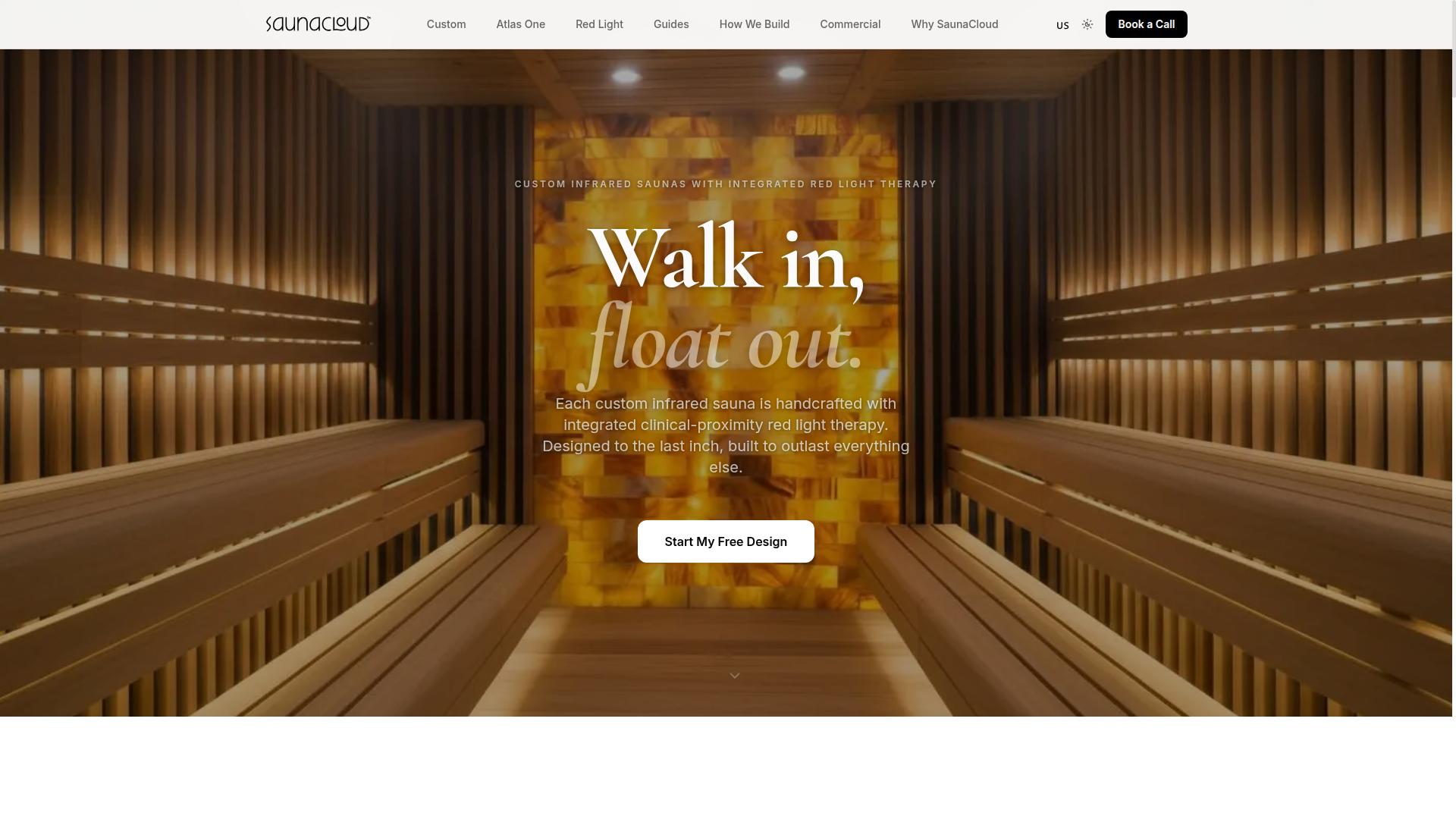
SaunaCloud designs and builds custom infrared saunas with integrated red light therapy panels inside its Diamond Springs, California facility. Founded in 2014, the company operates from locations in Diamond Springs, California and Montreal, Quebec.
The company has completed more than 3,000 installations across North America. The facility houses all engineering and manufacturing operations under one roof.
SaunaCloud engineers and handcrafts every component in-house. This includes VantaWave(r) heaters, CORE 5(tm) power supplies, printed circuit boards, Wi-Fi control systems, and red light therapy arrays.
The Atlas and Sierra models represent the core product lines. Both feature VantaWave(r) heaters with red light therapy panels positioned for clinical proximity during sessions.
This integrated approach combines infrared sauna heat with red light therapy in a single unit. Users experience both modalities without needing separate equipment or additional setup steps.
Manufacturing controls quality at every stage. The in-house process covers design, engineering, and assembly, which ensures consistent integration between heating elements and therapy panels.
Why SaunaCloud Is the Best for Built-in Red Light Therapy Panels
SaunaCloud positions its red light therapy panels directly within the sauna benches and backrests, creating a single unified wellness system. This integrated design removes the need for separate red light devices that often require additional space and setup. Users receive both heat therapy and light therapy in one streamlined experience.
The LED placement within benches creates clinical-proximity exposure at just 2 to 6 inches from the body. This distance matches professional photobiomodulation protocols used in clinical settings. The close range helps support mitochondrial function and ATP production during each session.
Aftermarket add-on solutions often sit farther from the body and lack the same precision. These external devices can create uneven exposure and require separate power sources. Built-in panels eliminate these issues by delivering consistent, targeted red light therapy throughout the sauna session.
All components are designed and manufactured in-house by SaunaCloud. This approach ensures seamless integration between the VantaWave heaters and the red light therapy system. The result is a cohesive wellness platform rather than a collection of mismatched parts.
Clear-grade kiln-dried Western Red Cedar forms the sauna structure without particle board, glues, or veneers. This non-toxic material choice supports the overall wellness focus of the integrated design. Users can enjoy both heat therapy and light therapy in an environment free from unnecessary chemical exposure.
The low-EMF VantaWave heaters complement the red light therapy panels by maintaining minimal electromagnetic interference. This combination supports comprehensive health optimization during each session. Research suggests that combining multiple wellness modalities can enhance overall benefits.
Users benefit from this unified approach because they can address multiple wellness goals at once. The integrated panels support skin rejuvenation, muscle recovery, joint pain relief, inflammation reduction, circulation improvement, and collagen synthesis simultaneously. This multi-benefit design makes each session more efficient than using separate devices.
SaunaCloud backs this integrated system with a lifetime warranty and has earned a 4.8 out of 5 Trustpilot rating from 217 verified reviews. The company also maintains a BBB A+ rating since 2015. These credentials reflect consistent quality in their manufacturing and design approach.
Clinical Proximity Red Light Integration
Clinical proximity placement delivers maximum photobiomodulation benefits by positioning LEDs within 2-6 inches of the user's skin during sauna sessions.
The science behind distance-based light therapy centers on how photons interact with cells. When light travels through air, intensity drops rapidly, reducing its ability to trigger cellular responses.
Research suggests that closer positioning allows more photons to reach mitochondrial chromophores. This interaction supports mitochondrial function and ATP production within muscle and skin tissues.
Saunacloud integrates this clinical approach into its infrared sauna designs. Built-in red light therapy panels maintain consistent spacing from skin contact points throughout each session.
This integration combines heat therapy with light therapy in a single wellness experience. Users receive both thermal benefits and photobiomodulation without needing separate equipment.
660nm Red + 850nm Near-Infrared LEDs
Dual-wavelength LED arrays combine 660nm red light for surface tissue with 850nm near-infrared for deeper muscle penetration.
The 660nm wavelength targets skin cells at shallow depths. This supports skin rejuvenation and collagen synthesis through direct interaction with epidermal and dermal layers.
The 850nm wavelength penetrates several centimeters into muscle tissue. This reaches deeper structures where it may support muscle recovery and reduce inflammation in larger muscle groups.
Saunacloud equips its Atlas and Sierra models with these specific LED wavelengths. The panels work alongside VantaWave ultra-low-EMF carbon heaters within the same cedar structure.
Optimal dosage typically involves 10-20 minute sessions at moderate intensity. Users should position themselves so the LED arrays face major muscle groups and skin areas requiring attention.
2-6 Inch Distance from Skin
Red light therapy panels are embedded within cedar benches and backrests at a fixed 2-6 inch distance from skin contact points.
This range represents the optimal therapeutic window for photobiomodulation delivery. Distances under 2 inches may cause discomfort, while distances over 6 inches reduce light intensity significantly.
Bench integration maintains consistent spacing regardless of user movement. The panels stay fixed within the cedar structure, eliminating the need for manual adjustment during sessions.
Positioning guidelines recommend sitting with your back against the panel-equipped backrest. Major muscle groups should face LED arrays for maximum exposure during each infrared sauna session.
Saunacloud constructs these panels using premium Western Red Cedar. The wood provides natural thermal properties while housing the LED arrays at precise therapeutic distances.
Key Features and What Makes SaunaCloud Stand Out
VantaWave(r) carbon heaters reach 190 degreesF surface temperature while maintaining under 3mG EMF emissions, often below 0.5mG. This combination ensures effective far-infrared heat delivery at 7.9 microns peak wavelength. The low-EMF design supports safe, extended therapy sessions.
SaunaCloud builds all components in-house, which allows precise integration of built-in red light therapy panels. The panels sit at clinical proximity of 2 to 6 inches within benches and backrests. This placement keeps the therapy close to the body during each session.
The modular design provides flexibility for different room layouts and user needs. Clear-grade kiln-dried Western Red Cedar forms every surface without particle board, glues, or veneers. This construction meets non-toxic standards for indoor wellness environments.
Digital control systems let users adjust heat, light intensity, and session length with ease. Bluetooth speaker integration adds audio options, while chromotherapy lighting supplies color-based mood support. Aromatherapy options complete the multisensory experience.
These features work together to combine heat therapy with red light therapy in one unit. The lifetime warranty reflects confidence in the materials and assembly. SaunaCloud earned a 4.8 out of 5 Trustpilot rating from 217 verified reviews and holds a BBB A+ rating since 2015.
Pricing and Plans
SaunaCloud provides custom pricing based on specific model configurations and size requirements for Atlas and Sierra models.
Custom pricing structures allow buyers to select built-in red light therapy panels that match exact specifications. This approach eliminates unnecessary costs from standard packages while ensuring each system delivers the intended photobiomodulation benefits.
Modular design directly influences cost flexibility. Users can add or remove LED panels that target near-infrared, mid-infrared, and far-infrared ranges without purchasing an entire new system. This structure supports gradual expansion as wellness needs evolve.
Complete kits typically include cedar wood construction, low-EMF electrical components, digital controls, and integrated sauna heater elements. These components work together to deliver both heat therapy and light therapy within one unit.
Project ranges vary according to the number of panels, sauna dimensions, and additional features such as chromotherapy lighting or aromatherapy systems. Buyers receive detailed quotes that reflect their chosen configuration rather than fixed retail tiers.
The modular structure keeps future upgrades straightforward. Additional red light therapy capacity can be integrated later without replacing the core sauna envelope or control systems.
Trust Signals
SaunaCloud demonstrates reliability through extensive installation history and comprehensive warranty coverage.
Customers need confidence when investing in built-in red light therapy panels for their infrared sauna. A proven company track record provides that assurance.
Support infrastructure matters throughout the entire ownership experience. This includes installation assistance and ongoing product protection.
3,000+ Installations Since 2014
Over 3,000 custom infrared sauna installations have been completed across North America since the company's founding.
Geographic reach spans the entire continent. This demonstrates consistent service delivery across diverse climates and building conditions.
Installation support services include detailed plans with phone and video assistance. These resources help customers complete their projects successfully.
Typical production timeframes run 7 to 8 weeks. This schedule allows proper preparation for each custom installation.
7-Year Limited Lifetime Warranty
Every SaunaCloud sauna includes a 7-year limited lifetime warranty covering heaters, electronics, and structural components.
This coverage extends to built-in red light therapy panels and their integration systems. The warranty protects the complete wellness technology investment.
Claim processes receive direct manufacturer support. This ensures straightforward resolution when service needs arise.
Complete kits ship with all components and fasteners included. This approach eliminates missing pieces during initial setup and future warranty service.
Who Should Use SaunaCloud
Homeowners seeking clinical-grade wellness technology and professional clinics requiring integrated recovery solutions represent primary customer segments.
Homeowners benefit from built-in red light therapy panels that address multiple wellness goals at once. Pain relief becomes more accessible when near-infrared wavelengths target deep muscle tissue and reduce inflammation.
Sleep improvement occurs through consistent evening sessions that regulate circadian rhythms. Stress reduction follows as heat therapy combined with red light therapy calms the nervous system and promotes relaxation.
Cardiovascular health gains support from circulation improvement during infrared sauna sessions. Research suggests that regular heat therapy may enhance blood flow and support heart function over time.
Residential applications include home gyms where homeowners integrate full-spectrum sauna units with digital controls and Bluetooth speakers. Cedar wood construction provides a natural environment while LED panels deliver targeted photobiomodulation.
Commercial settings such as wellness centers and physical therapy clinics use modular design to accommodate multiple clients. Non-toxic materials and low-EMF construction meet the safety standards required in professional environments.
Target demographics include athletes focused on muscle recovery who use built-in red light therapy panels to accelerate tissue repair. Older adults seeking joint pain relief find chromotherapy lighting and aromatherapy enhance their sessions.
Wellness goals center on health optimization through mitochondrial function and ATP production support. Skin rejuvenation and collagen synthesis benefits appeal to those prioritizing appearance alongside physical recovery.
Final Verdict
SaunaCloud delivers a clinically integrated infrared sauna and red light therapy solution backed by 7-year warranty and proven installation expertise.
Built-in red light therapy panels sit directly in the sauna walls. This placement keeps the light source at proper clinical distance from the user.
Low-EMF technology protects sensitive users. The heating elements and LED panels reduce electromagnetic exposure during sessions.
Support extends beyond the purchase. SaunaCloud provides installation guidance plus ongoing warranty coverage for seven years.
The 6100 Enterprise Dr. Suite G, Diamond Springs, CA 95619 location serves as the main contact point. Customers can reach the team at 800-370-0820 or [email protected].
Showroom visits require appointments. This ensures dedicated attention during product demonstrations and consultations.
Each SaunaCloud unit combines heat therapy with photobiomodulation in a single structure. This design removes the need for separate light devices.
Non-toxic materials and cedar wood construction maintain air quality. Users experience both heat and light benefits without chemical off-gassing concerns.
The modular approach allows customization of panel placement. Homeowners select the number and position of red light therapy units based on their space.
Digital controls manage both temperature and light settings. Users adjust intensity levels through simple interfaces without leaving the sauna.
Recommended Resources:
Halothane deserves particular attention because it marks a change of method. The earlier agents were discovered: someone inhaled a substance that already existed and noticed what happened. Halothane was specified. The properties wanted were written down first, including non-flammability, chemical stability, sufficient volatility and low reactivity, and a molecule was then designed to meet them. That is a different intellectual operation, and it is the point at which the agent record stops being a history of accidents.
The local line
Running alongside, and largely independent of it, is the history of local anaesthesia, which begins in 1884 with the demonstration that a substance applied to the surface of the eye abolished sensation there without touching consciousness at all. Within a year the same principle was applied to nerve trunks, producing insensibility in the territory a nerve supplies, and in 1898 to the spinal fluid, producing it below the level of injection.
Conceptually this is a separate discovery. General anaesthesia removes the person who would feel the pain; local anaesthesia removes the signal before it arrives. That the two were pursued as one subject is a fact about professional organisation rather than about the underlying science, and it is one reason the mechanistic literature stayed confused for so long: local anaesthetic action on nerve conduction was understood decades before anything useful could be said about general anaesthetic action on the brain.
Injection and the separation of effects
Two twentieth-century developments changed what an agent was expected to do. The first was the arrival of short-acting intravenous induction in the 1930s, which meant that the unpleasant early minutes of inhalation could be skipped entirely. The second, in 1942, was the report of a plant-derived compound that produced muscular relaxation without producing unconsciousness.
That second development is more significant than it sounds. Before it, relaxation of the muscles had to be obtained by giving enough inhalational agent to reach a depth at which the muscles relaxed, which is to say by pushing the patient a long way down. Once relaxation could be produced separately, the depth required fell sharply, and the target of anaesthesia stopped being a single state and became a set of separable components: unconsciousness, absence of movement, and suppression of the responses to injury. Those components can be produced by different substances acting in different places, and that insight organises everything written about mechanism afterwards.
Dates and terms this page turns on
- Longest gap, preparation to use
- Nitrous oxide, 1772 to 1844
- First agent designed to specification
- Halothane, 1951
- Local anaesthesia demonstrated
- 1884
- Spinal anaesthesia reported
- 1898
- Intravenous induction in use
- 1930s
- Relaxation separated from depth
- 1942